King's Decree: A Typeface with Royal Authority
There's a moment in a design project when you need more than just letters on a screen. You need presence. You need a typeface that doesn't just spell out words but declares them with conviction. That's the space where King's Decree operates. This isn't a quiet, background font. It's a blackletter typeface drawn from the world of medieval manuscripts, gothic stone carvings, and royal proclamations. Its sharp strokes and intricate details carry the weight of history, offering a dramatic and elegant tool for designers who want to make a statement.
The Visual Character of King's Decree
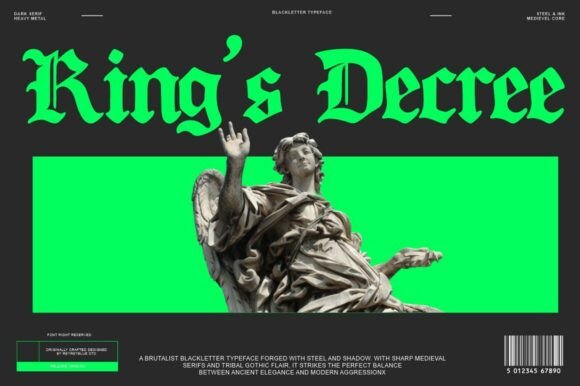
At first glance, King's Decree commands attention. Its personality is rooted in the Old English style, but it's refined for contemporary use. You'll notice the high contrast between thick and thin strokes, giving each letter a dynamic, almost architectural quality. The serifs are pronounced and decorative, and the overall letterforms have a vertical energy that feels both structured and slightly ornate. This isn't a gothic font that feels dated or illegible; it balances its historical inspiration with clarity. It includes a full set of uppercase and lowercase characters, numerals, punctuation, and multilingual support, making it a versatile premium font for serious work.
The appeal of King's Decree lies in its duality. It feels ancient yet timeless, authoritative yet artistic. It can evoke the solemnity of a historical document or the dark elegance of a fantasy novel cover. This makes it a powerful creative font for projects that need to tell a story through typography alone.
Where This Font Makes Its Mark
Choosing the right typeface is about matching the tool to the task. King's Decree excels as a display font, meaning it's built for impact at larger sizes. Think of it as the headline act, not the supporting cast. Its strength is in grabbing focus and setting a specific tone.
For logo design and brand identity, it's a natural fit for businesses that want to project heritage, craftsmanship, or a sense of tradition. A craft brewery, a bespoke tailor, a specialty coffee roaster, or a historical society could use King's Decree in their logo to immediately communicate a story of depth and quality. It's a commercial font that can form the cornerstone of a visual identity that feels established and credible.
In editorial design and packaging design, it brings drama. Imagine it on the cover of a fantasy novel, the title card of a period film poster, or the label of a premium whiskey. It elevates the subject matter. For apparel design and merchandise, it's equally effective. A bold wordmark on a t-shirt, a sleeve print, or a hat using King's Decree transforms simple clothing into a statement piece.
Even in digital spaces, it finds its place. Used sparingly in web design for a hero section headline or in social media graphics for a campaign launch, it can stop the scroll. The key is context. It's not for body text or lengthy paragraphs. It's for the moments where you need your audience to pause and take notice.
Practical Guidance for Using King's Decree
Adopting a font like this requires some strategic thinking. Here’s how to approach it practically.
Evaluate the Project Fit. Ask yourself: does my project call for a sense of history, authority, or dramatic flair? If you're designing a tech startup's app interface, King's Decree is likely the wrong tool. But if you're creating a brand for a medieval-themed restaurant, a fantasy game, or a luxury watch brand with a focus on timeless craftsmanship, it's worth serious consideration.
Master the Font Pairing. This is critical. King's Decree is a strong personality. Pairing it with another ornate serif font or a complex script font will create visual clutter. Instead, let it shine by pairing it with a clean, neutral counterpart. A simple sans serif font for body text provides a perfect contrast, allowing the blackletter's details to stand out without overwhelming the viewer. A geometric sans serif or a humanist sans serif often works beautifully. The goal is balance, not competition.
Consider Readability and Hierarchy. Because King's Decree is a display font, use it for short, high-impact text: headlines, titles, logos, and pull quotes. Avoid using it for small sizes or long sentences where legibility could suffer. Use it to create a strong visual hierarchy—let it dominate the top of the page or screen, then use your paired font to deliver the detailed information below.
Review the Included Styles. Before purchasing, check what's included. King's Decree comes with uppercase, lowercase, numbers, and punctuation. Does it have the specific characters or ligatures your project needs? Does its multilingual support cover the languages you're targeting? A premium font is an investment, so ensure it has the technical features for your workflow.
Understand the Licensing. If your project is commercial—a product for sale, a client's branding, a monetized website—you need a commercial font license. Always verify the license terms of King's Decree to ensure they cover your intended use. This protects you legally and supports the type designers who create these valuable design assets.
Final Thoughts on Choosing a Commanding Typeface
In a world saturated with minimalism and geometric sans serifs, a font like King's Decree offers a different path. It’s for the designer or brand strategist who understands that typography is more than just legible text—it's a carrier of emotion and context. It’s a tool for modern typography that isn't afraid to reference the past to make a bold statement in the present.
Used thoughtfully, it doesn't just decorate a design; it defines its character. It can turn a simple project into something memorable, giving your work the visual weight and strong visual impact needed to stand apart. Whether for a personal creative project or a commercial brand seeking a distinctive voice, King's Decree offers a direct line to that sense of timeless authority.